March 29, 2026
The First Ninety
Onyx does not yield easily.
It is softer than marble and more fragile than granite. Formed near the surface of the earth, it carries natural fissures and variations before a single tool touches it.
It also allows light to pass through.
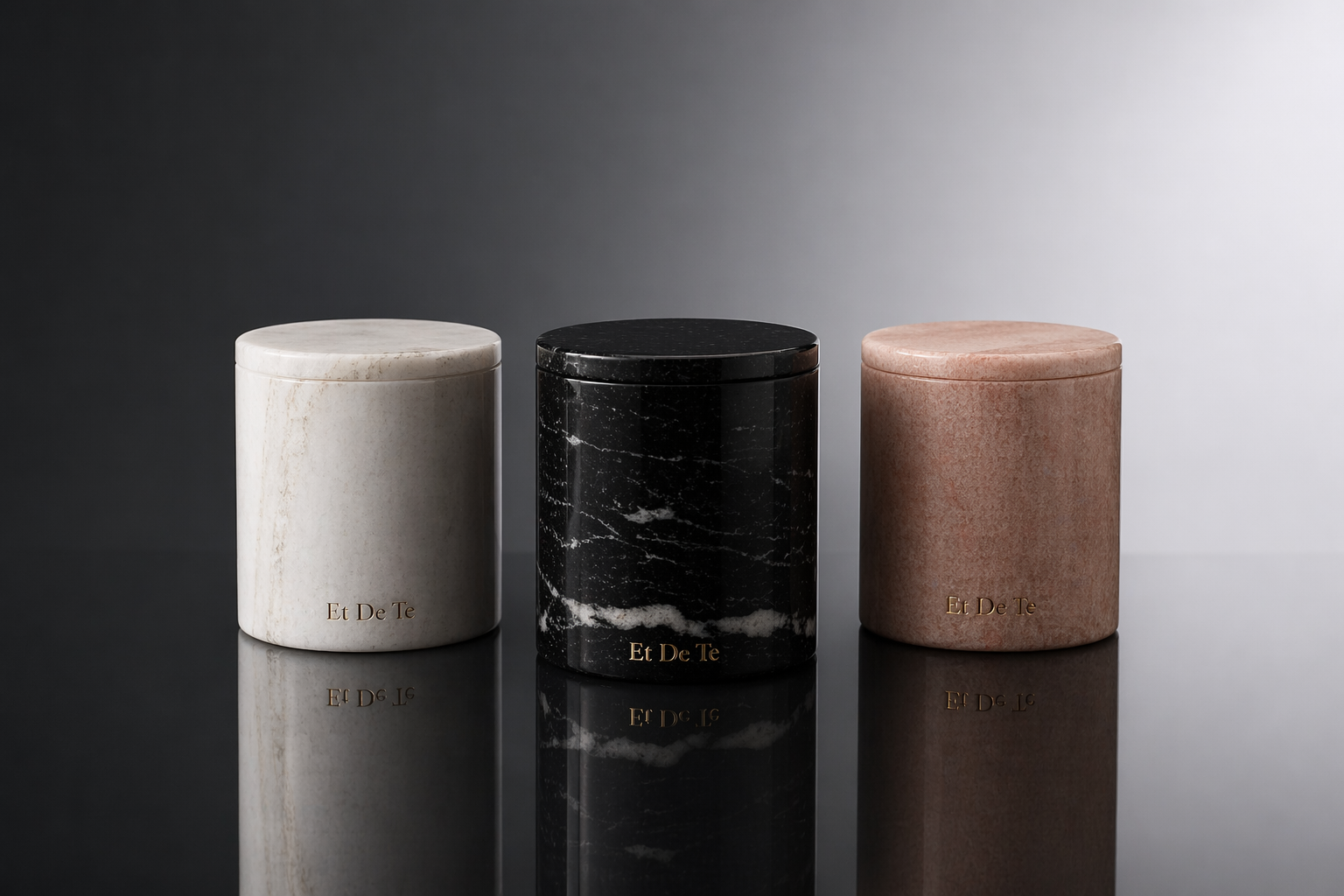
That is why we chose it for the first works created by Et De Te. When a flame burns inside white or pink onyx, light passes through the walls of the vessel and reveals formations that existed long before the object did.
To carry that light, the walls have to be thin.
Too thick, and much of the translucency is lost. Too thin, and the risk of fracture increases as the stone is cut, hollowed, and finished.
The vessels in the First Edition were finished at eight millimeters. Reaching that proportion required the judgment of craftspeople who have spent years working with natural stone, understanding how far each piece can be taken and when the material has reached its limit.
Some pieces did not reach that point.
Indian Black Marquina presented a different challenge.
Its character lies in the mineral formations that pass through the black stone. Every block carries its own history, and cutting it into an object reveals only part of what was present inside.
What emerged could not be predicted beforehand.
The First Edition was limited to ninety pieces because material and craft determined how many could meet the standard of the work.
Each surviving vessel carries the particular formation of the stone from which it was made. Its veining, tonal variation and relationship with light cannot be reproduced in another piece.
That is what the first ninety represent.
They are the beginning of Et De Te, but they also establish something we intend to carry forward: the material is never incidental to the object. Its history becomes part of the object's own.
When these ninety are gone, their exact formations will be gone with them.
Not because we decided that.
Because the stone already did.
Et De Te